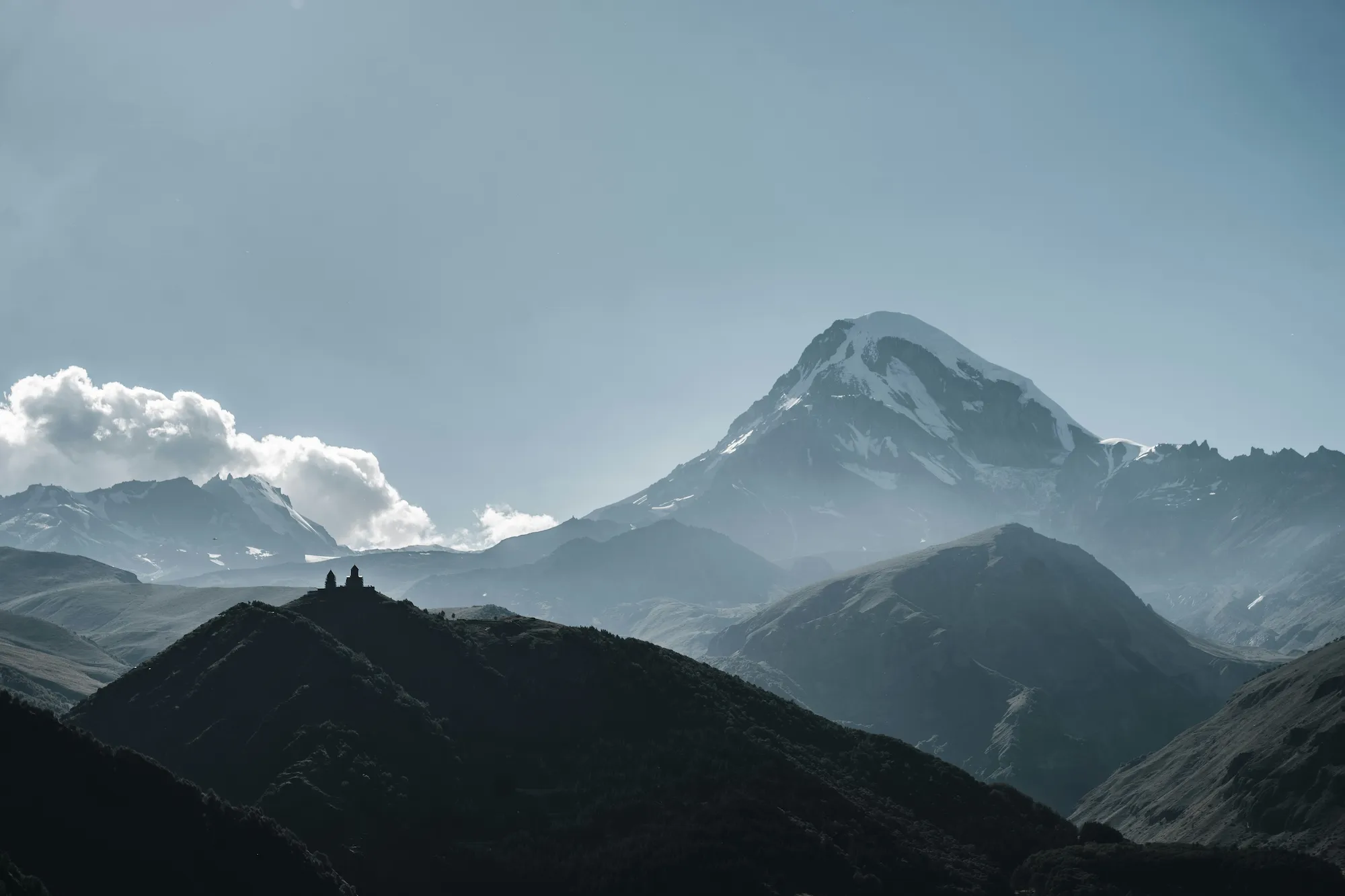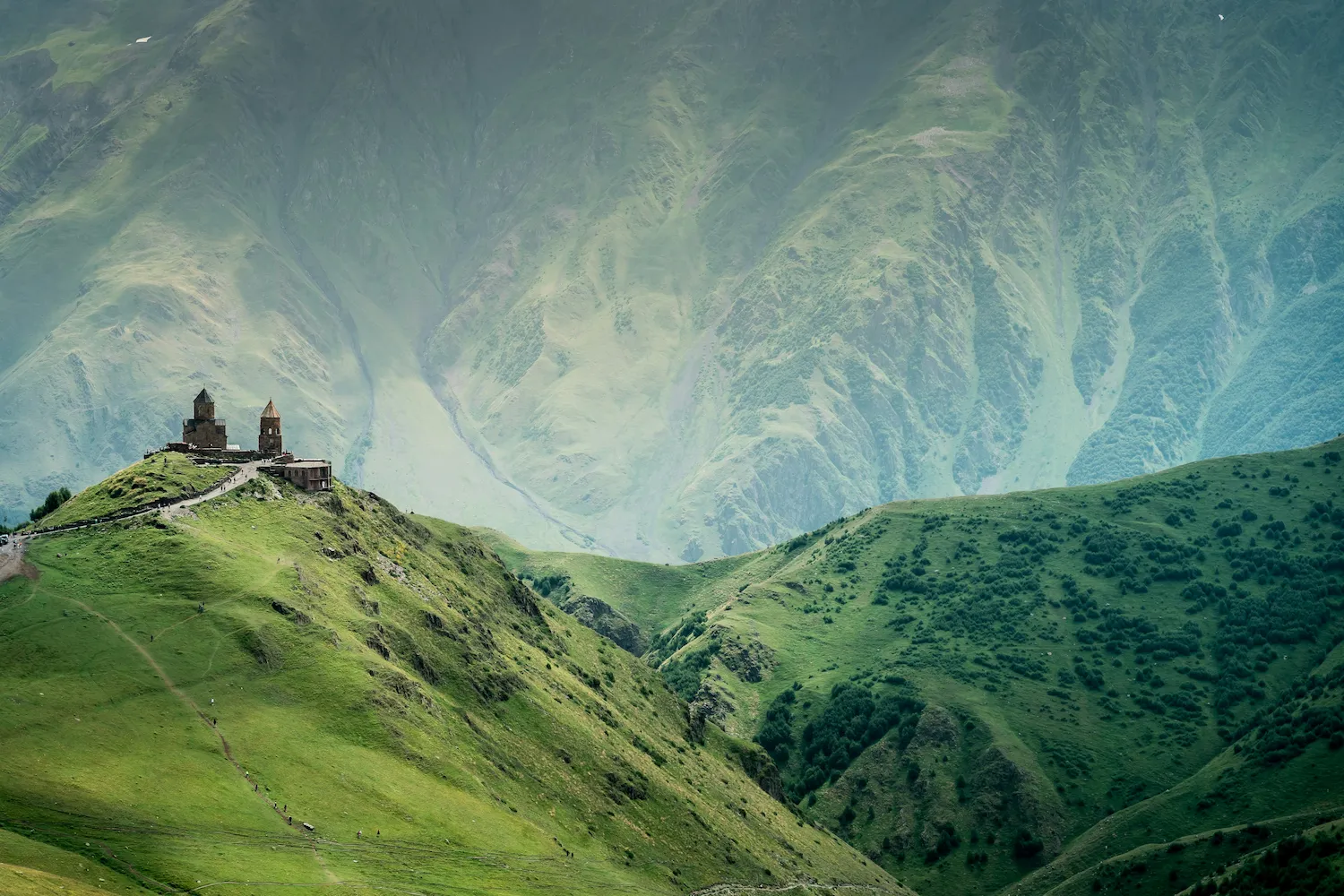
Most people see Kazbegi as a single photo: Gergeti Trinity Church with Mount Kazbek behind it, and a great day trip from Tbilisi delivers exactly that. But if you have a bit more time, staying overnight in Stepantsminda opens up even more — a chance to catch sunrise over the mountains, wait out the weather for a clearer view, and explore a region that has plenty going on beyond the church on the hill.
This guide covers both. We've grouped everything by how much effort it takes to reach — easy stops you can drive to on a day trip, short walks anyone can manage, and longer day hikes for those with an extra day or two to spare. Planning the drive itself? See our Kazbegi day-trip travel guide for transport, road conditions and stops on the Georgian Military Highway.
Easy Places by Car
These don't require hiking boots — just a car, a driver, or a short walk from wherever you park.
1. Dariali Gorge & Dariali Monastery
Continue past Stepantsminda toward the Russian border and the highway enters Dariali Gorge — a narrow, steep-walled canyon that's been a strategic mountain passage since antiquity, sometimes called one of the "Gates of the Caucasus." At the border checkpoint sits a monastery complex with a small wine cellar where you can taste local wine, next to the Terek River running wild below. It's not part of the standard day-trip route, but it's an easy add-on if you have your own transport or a driver willing to go a little further.
2. Sno Village & the Stone Heads
About 8 km from Kazbegi, just off the road toward Juta, the small village of Sno (home to around 150 people) has an unlikely claim to fame: a set of giant granite heads carved by local sculptor Merab Piranishvili, depicting Georgian writers, poets, and historical figures — Shota Rustaveli, Ilia Chavchavadze, Vazha Pshavela, and others. It's a quirky, unexpected stop, entirely free to visit (a small donation box sits nearby), and takes only 10–15 minutes off your route. Sno is also home to the family residence of the Patriarch of the Georgian Orthodox Church and the ruins of a 16th-century watchtower.
3. St. Elias (Elia) Church viewpoint
About 3 km from Stepantsminda, on Mount Elia at roughly 2,000 m, this small monastery complex is one of the best easy viewpoints in the area — from here you get a clean sightline over the town, Gergeti Trinity Church, and Mount Kazbek's glacier, without the crowds that gather at Gergeti itself. A good stop for sunset if you're staying overnight.
Short Walks and Easy Hikes
Nothing technical here — just proper shoes and a bit of time.
4. Gveleti Waterfalls
About 7 km from Stepantsminda in the Dariali Gorge, Gveleti has two waterfalls reachable by an easy trail (roughly 3.5–4 km round trip in total, around 330 m of elevation gain). The smaller waterfall is a 10–15 minute walk from the trailhead; the bigger one takes closer to 30 minutes and involves a short scramble over rocks near the end. The big waterfall drops into a heart-shaped pool nicknamed the "lake of love." It's free, family-friendly, and one of the most popular short outings in the area — expect company in peak season.
5. Arsha waterfall (and the fortress ruins above it)
Arsha is one of the oldest villages in the Kazbegi area, about 5 km from Stepantsminda, and once held real strategic importance — the ruins of Arsha Fortress still sit on the ridge above, a reminder of its former role defending the Khevi region. This is a good option if you want a few hours outdoors without committing to a full day: the route isn't too difficult, though there's some elevation gain, and it leads through quiet mountain scenery with views of the valley, the fortress ruins, and the waterfalls themselves.
There are two waterfalls here. The first — a relatively easy 1.5 km from the village — is the one most people see. The second, another 10–15 minutes further up a steeper stretch, is known locally as "Woman's Hair," named for the way the water falls in long, thin streams. How much of this you can actually reach depends on the season: in early June, the lower waterfall was running so powerfully that crossing the stream to reach the upper one wasn't really possible without getting soaked — but even the first waterfall alone made the walk worthwhile.
If you want to go further, the trail continues up toward the fortress ruins for views back over the valley — a nice add-on if you've done the short version before and fancy a bit more climbing.
6. Kazbegi Panorama Viewpoint
From the parking area near Gergeti Trinity Church, follow the trail uphill towards Sabertse Pass for around 20–30 minutes. A grassy viewpoint along the way opens up wide views over the church, Stepantsminda and the surrounding mountains. The climb is short and straightforward in good weather, although the trail is noticeably uphill. You can turn back here without continuing on the much longer route towards Gergeti Glacier.
Best Day Hikes from Kazbegi
These are worth making a separate outing for — from an easy couple of hours at Sakhizari to full-day hikes in Juta and Truso.
7. Sakhizari Cliffs from Sioni
One of the easiest hikes in the Kazbegi area starts from the village of Sioni. The walk to the unusual Sakhizari rock formations takes only a couple of hours and has very little elevation gain, making it a good option if you want a proper mountain outing without a strenuous climb.
In September, you may also find wild blueberries, strawberries, and raspberries growing along the trail.
8. Juta & Chaukhi Valley
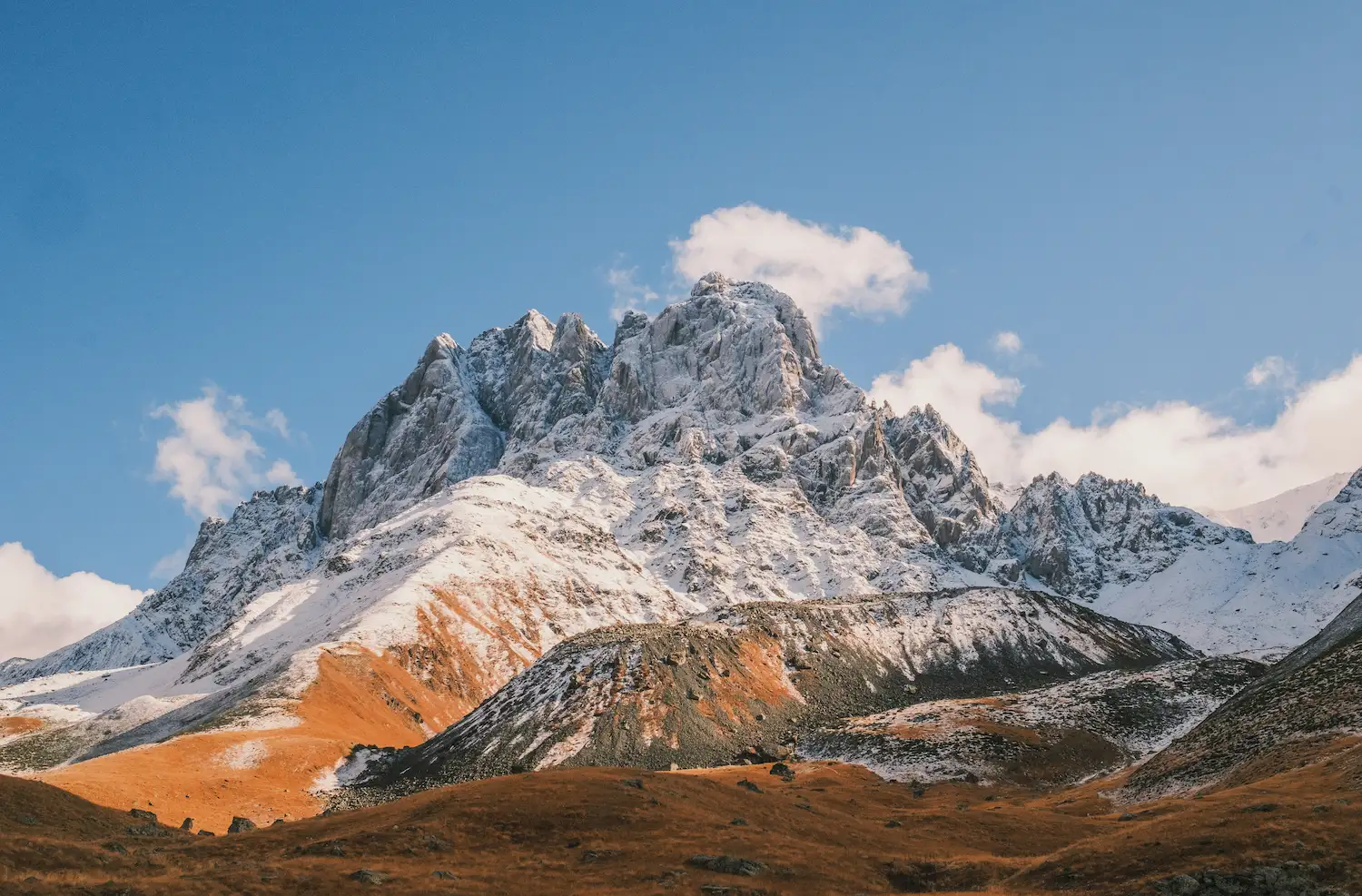
Juta is a small village about 20 km from Kazbegi (30–40 minutes by car or shared 4×4), sitting at 2,200 m and framed by the jagged Chaukhi Massif — often called the "Georgian Dolomites." From Juta, a manageable trail leads past the Fifth Season lodge to Chaukhi Lake, an 8 km round trip that most people complete in 2–6 hours depending on pace and stops. Fitter hikers can continue another 2–3 hours up to Chaukhi Pass at over 3,000 m for sweeping views on both sides of the ridge — but check locally whether the pass is clear of snow first; it can stay snow-covered into mid-June. The valley is best visited between July and September, when conditions are most stable.
9. Truso Valley
A completely different landscape from the rest of Kazbegi: a wide, largely flat valley about 20 km south of town (via Kobi), known for colourful mineral travertines, an old abandoned village, small monasteries, and the turquoise Abano mineral lake. The full route to Zakagori Fortress and back is around 21–22 km, taking 6–8 hours, but it's an easy grade throughout — no steep climbs, just distance. You can shorten it significantly by driving further into the valley before starting to walk. One practical note: the fortress sits close to the South Ossetia boundary line, so border guards are present and you'll need to carry your passport.
10. Gergeti Glacier — for experienced hikers only
This is the one to be honest about. The route toward Gergeti Glacier climbs well above the tree line toward the Meteo Station at roughly 3,650 m, on the same general route used for Mount Kazbek ascents. It's a serious mountain hike — significant elevation gain, changeable alpine weather, and terrain that isn't forgiving of the wrong shoes or an off day. This isn't a spontaneous add-on to a Gergeti Trinity Church visit; it needs proper planning, ideally a local guide, and honest self-assessment of your fitness and experience. If in doubt, this is one to save for a dedicated multi-day mountain trip rather than squeezing in during a regular Kazbegi stay.
How Many Days to Spend in Kazbegi
- 1 day: Gergeti Trinity Church, the Panorama Viewpoint just behind it, plus Dariali Gorge or Sno village on the way. This is the classic day-trip pace, and it's a full day even without a longer hike.
- 2 days: Add Gveleti Waterfalls, Arsha, or the Juta day hike to Chaukhi Lake. Two days is the sweet spot for seeing beyond the postcard view without a big time commitment.
- 3 days: Add Truso Valley or a longer hike toward Chaukhi Pass. Three days lets you properly spread things out, wait for a good weather window, and not feel rushed on any single hike.
Practical Tips
- Start early for mountain views. Cloud tends to gather around Kazbek and the higher peaks as the day goes on — mornings usually offer the clearest sightlines.
- Weather changes quickly. A clear morning can turn misty by early afternoon, especially at altitude. Don't build a whole day around one specific view.
- Bring layers even in summer. Temperatures at Gergeti and above can be noticeably cooler than in Stepantsminda itself, let alone Tbilisi.
- Proper shoes matter even for "easy" walks. Trails to Gveleti and Arsha are gentle but often loose, rocky, or muddy after rain — trainers work, but grip helps.
- Some places need a car, 4×4, or local driver. Sno, Juta, and the Dariali Gorge stops aren't reachable by the standard Kazbegi marshrutka — you'll need your own transport or a taxi arranged locally.
- In winter and spring, check road and trail conditions first. Juta and Truso in particular can be difficult or inaccessible outside the main hiking season (roughly June to September), and some routes close entirely under snow. For a wider season-by-season view, see our Best Time to Visit Georgia guide.
However you split your time, Kazbegi rewards travelers who stay a little longer than the standard day trip — the church on the hill is only the beginning of what's up here.